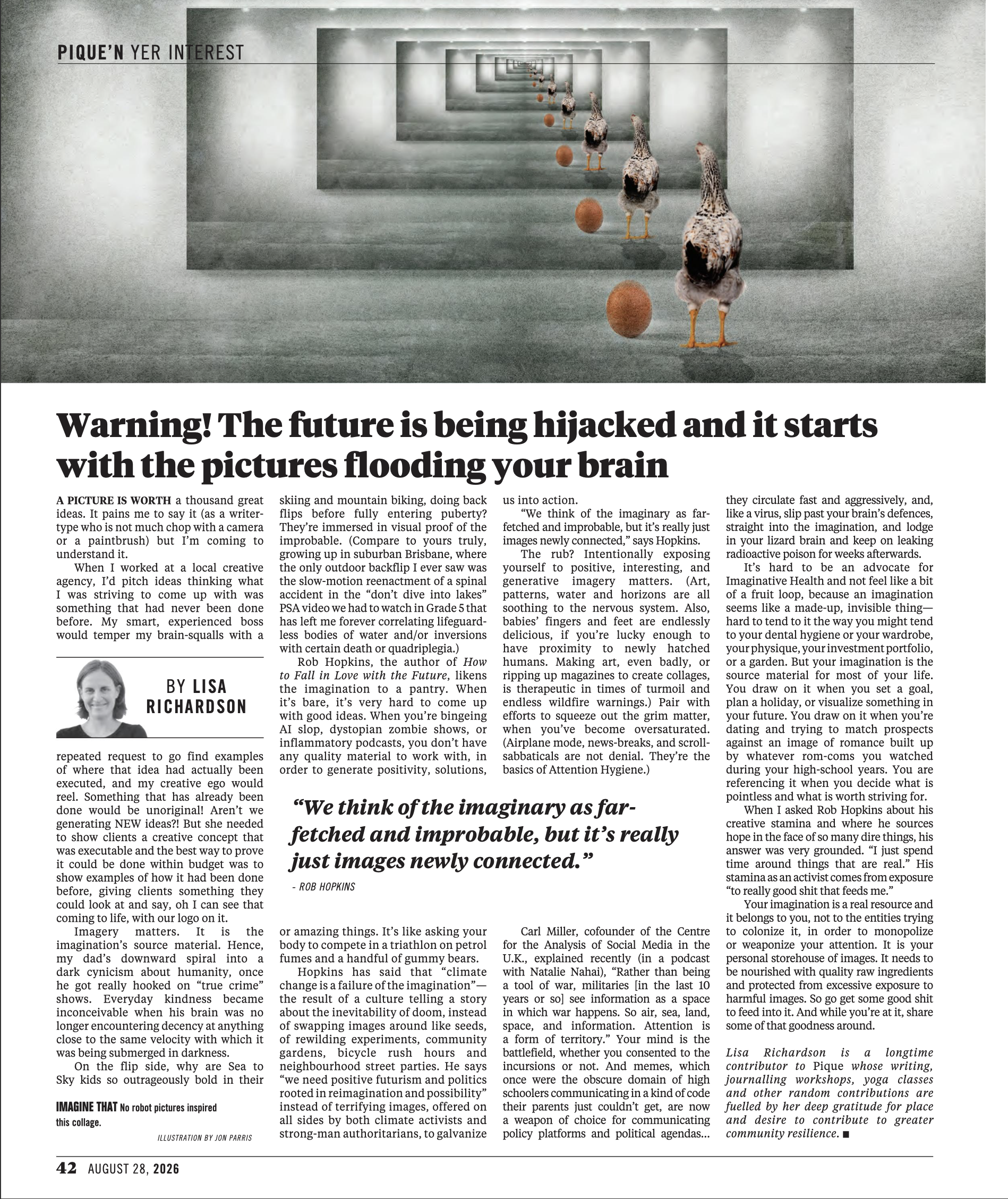
A picture is worth a thousand great ideas. It pains me to say it, (as a writer type who is not much chop with a camera or a paintbrush,) but I’m coming to understand it.
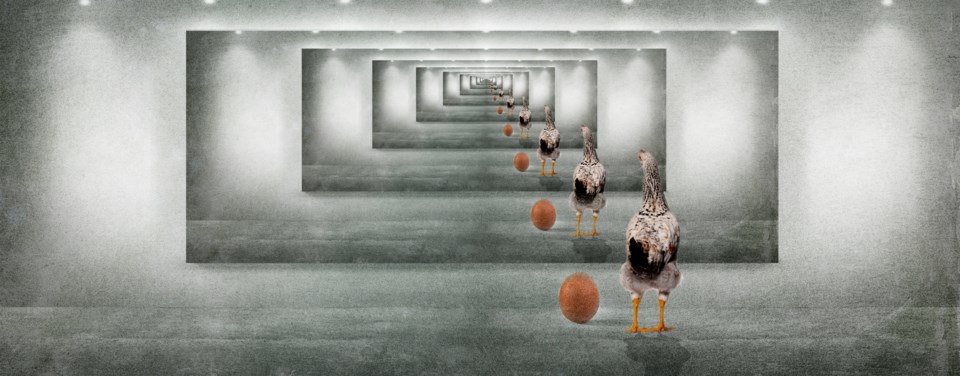
When I worked at a local creative agency, I’d pitch ideas thinking what I was striving to come up with was something that had never been done before. My smart experienced boss would temper my brain-squalls with a repeated request to go find examples of where that idea had actually been executed, and my creative ego would reel. Something that has already been done would be unoriginal! Aren’t we generating NEW ideas?! But she needed to show clients a creative concept that was executable and the best way to prove it could be done within budget was to show examples of how it had been done before, giving clients something they could look at and say, oh I can see that coming to life, with our logo on it…
Imagery matters. It is the imagination’s source material. Hence, my dad’s downward spiral into a dark cynicism about humanity, once he got really hooked on “true crime” shows. Every day kindness became inconceivable, because his brain was not encountering decency at anywhere near the same volume or intensity as it was being soaked in darkness.
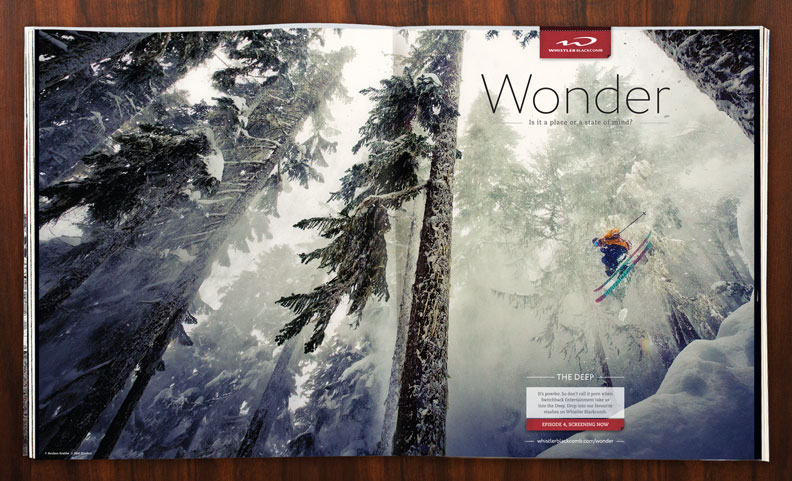
On the flip side, why are Sea to Sky kids so outrageously bold in their skiing and mountain biking, doing back flips before fully entering puberty? They’re immersed in visual proof of the improbable. (Compare to yours truly, growing up in suburban Brisbane, where the only outdoor backflip I ever saw was the slow-motion reenactment of a spinal accident in the “don’t dive into lakes” PSA video we had to watch in grade five that has left me forever correlating lifeguard-less bodies of water and/or inversions with certain death or quadriplegia.)
Rob Hopkins, the author of How to Fall in Love with the Future, likens the imagination to a pantry. When it’s bare, it’s very hard for you to come up with good ideas. When you’re bingeing AI slop, dystopian zombie shows, or inflammatory podcasts, you don’t have any quality material to work with, to try and generate positivity, solutions, or amazing things. It’s like asking your body to compete in a triathlon, on petrol fumes and a handful of gummy bears.
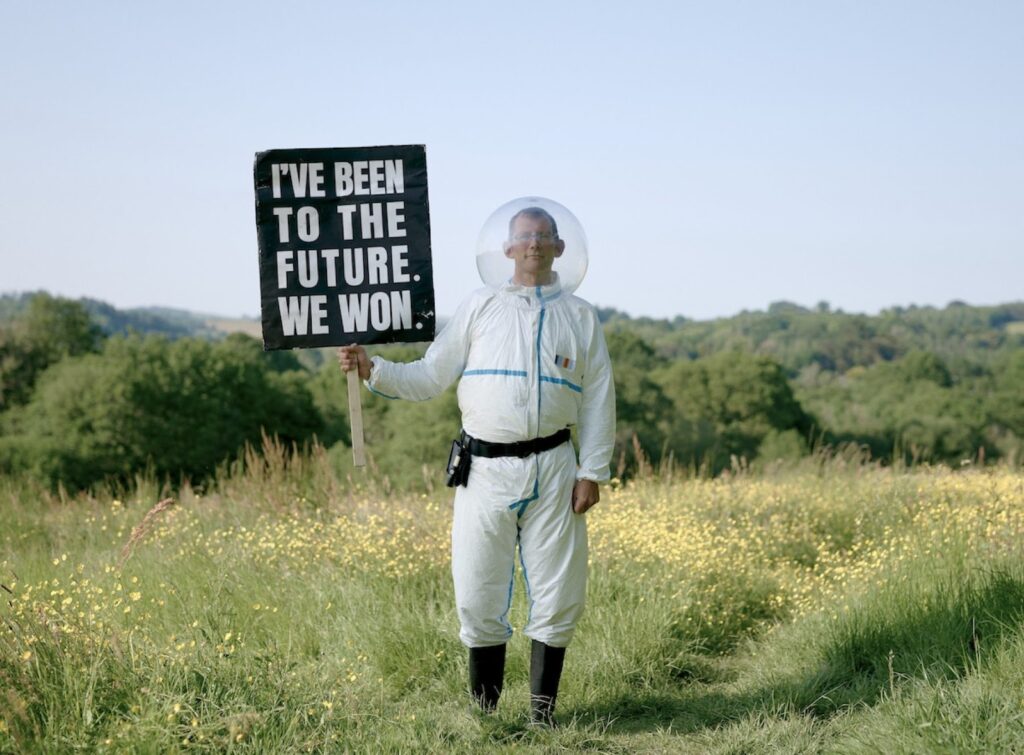
He has said that “climate change is a failure of the imagination” – the result of a culture telling a story about the inevitability of doom, instead of swapping images around like seeds, of rewilding experiments, community gardens, bicycle rush hours and neighbourhood street parties. Hopkins says “we need positive futurism and politics rooted in reimagination and possibility” instead of terrifying images, offered on all sides by both climate activists and strong-man authoritarians.
“We think of the imaginary as far-fetched and improbable, but it’s really just images newly connected,” says Hopkins.
So, intentionally exposing yourself to positive images, matters. (Art, patterns, water and horizons are all soothing to the nervous system. Also, babies’ fingers and feet are endlessly delicious, if you’re lucky enough to have proximity to newly hatched humans. Making art, even badly, or ripping up magazines to create collages, is weirdly therapeutic.) As does squeezing out the grim, when you’ve become oversaturated. (Airplane mode, news-breaks, and scroll-sabbaticals are not denial. They’re the basics of Attention Hygiene.)
Carl Miller, cofounder of the Centre for the Analysis of Social Media in the UK, explains (in a podcast with Natalie Nahai),
“Rather than being a tool of war, militaries [in the last 10 years or so] see information as a space in which war happens. So air, sea, land, space, and information. Attention is a form of territory.”
Your mind is the battlefield, whether you consented to the incursions or not. And memes, which once were the obscure domain of high schoolers communicating in a kind of code their parents just couldn’t get – are now a weapon of choice for communicating policy platforms and political agendas… they circulate fast and aggressively, and, like a virus, slip past your brain’s defences, straight into the imagination, and lodge in your lizard brain and keep on leaking radioactive poison for weeks afterwards.
It’s hard to be an advocate for Imaginative Health and not feel like a bit of a fruit loop, because an imagination seems like a made-up invisible thing — hard to tend to it the way you might tend to your dental hygiene or your wardrobe, your physique, your investment portfolio, or a garden. But your imagination is the Source material for most of your life. You draw on it when you set a goal, plan a holiday, or visualize something in your future. You draw on it when you’re dating and trying to match prospects against an image of romance built up by whatever rom-coms you watched during your high school years. You are referencing it when you decide what is pointless and what is worth striving for.
When I asked Rob Hopkins about his creative stamina and where he sources hope in the face of so many dire things, his answer was very grounded.
“I just spend time around things that are real.” His stamina as an activist comes from exposure, “to really good shit that feeds me.”
Your imagination is a real resource and it belongs to you, not to the entities trying to colonize it, in order to monopolize or weaponize your attention. It is your personal storehouse of images. It needs to be nourished with quality raw ingredients and protected from excessive exposure to harmful images. So go get some good shit to feed it. And share some of that around.