Whistler’s award-winning landscape architect, “the Patio King,” explains why a fire and an outlook are essential ingredients to the al fresco dining experience
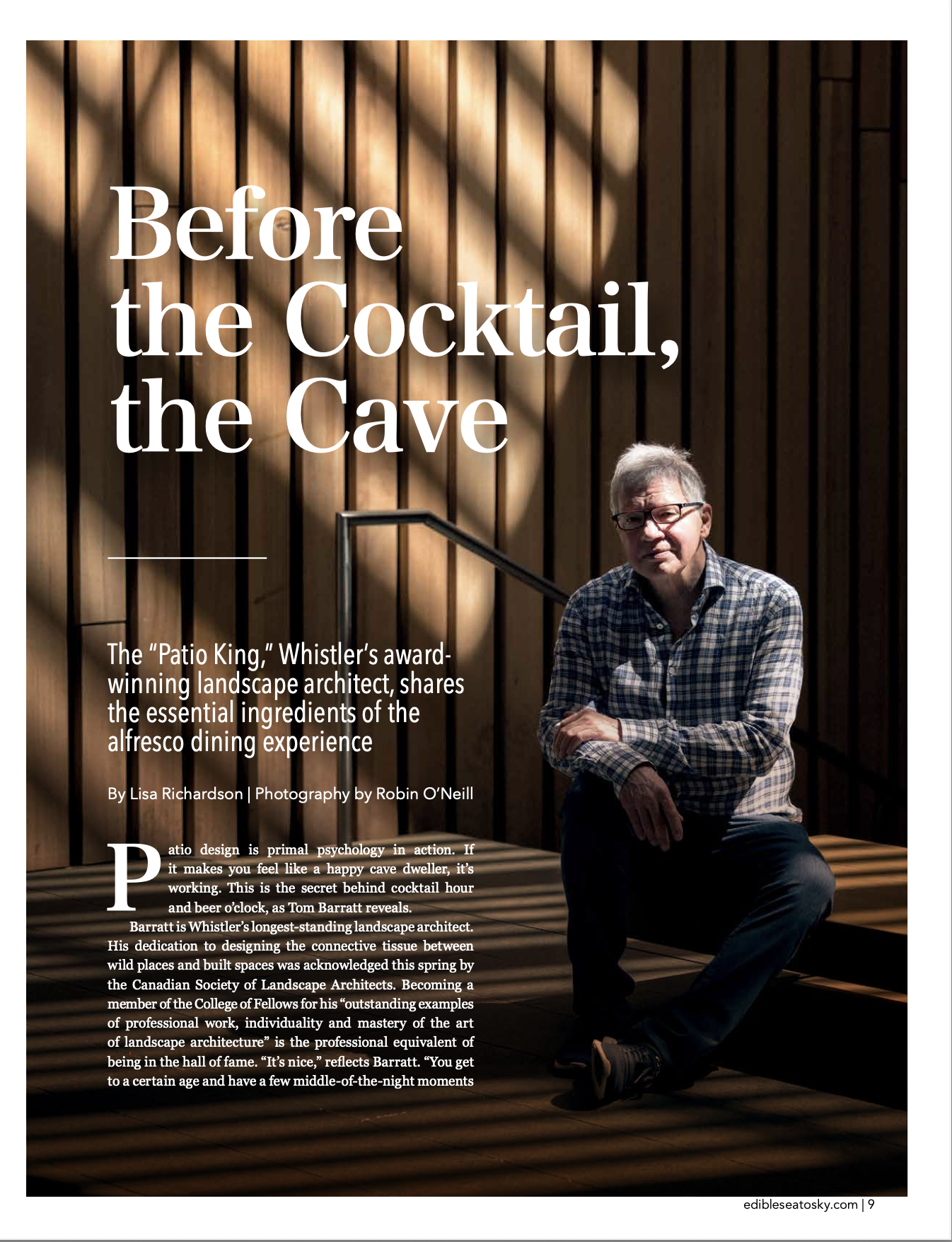
Patio design is primal psychology in action. If it makes you feel like a happy cave dweller, it’s working. This is the secret sauce behind cocktail hour and beer o’clock, as Tom Barratt reveals.
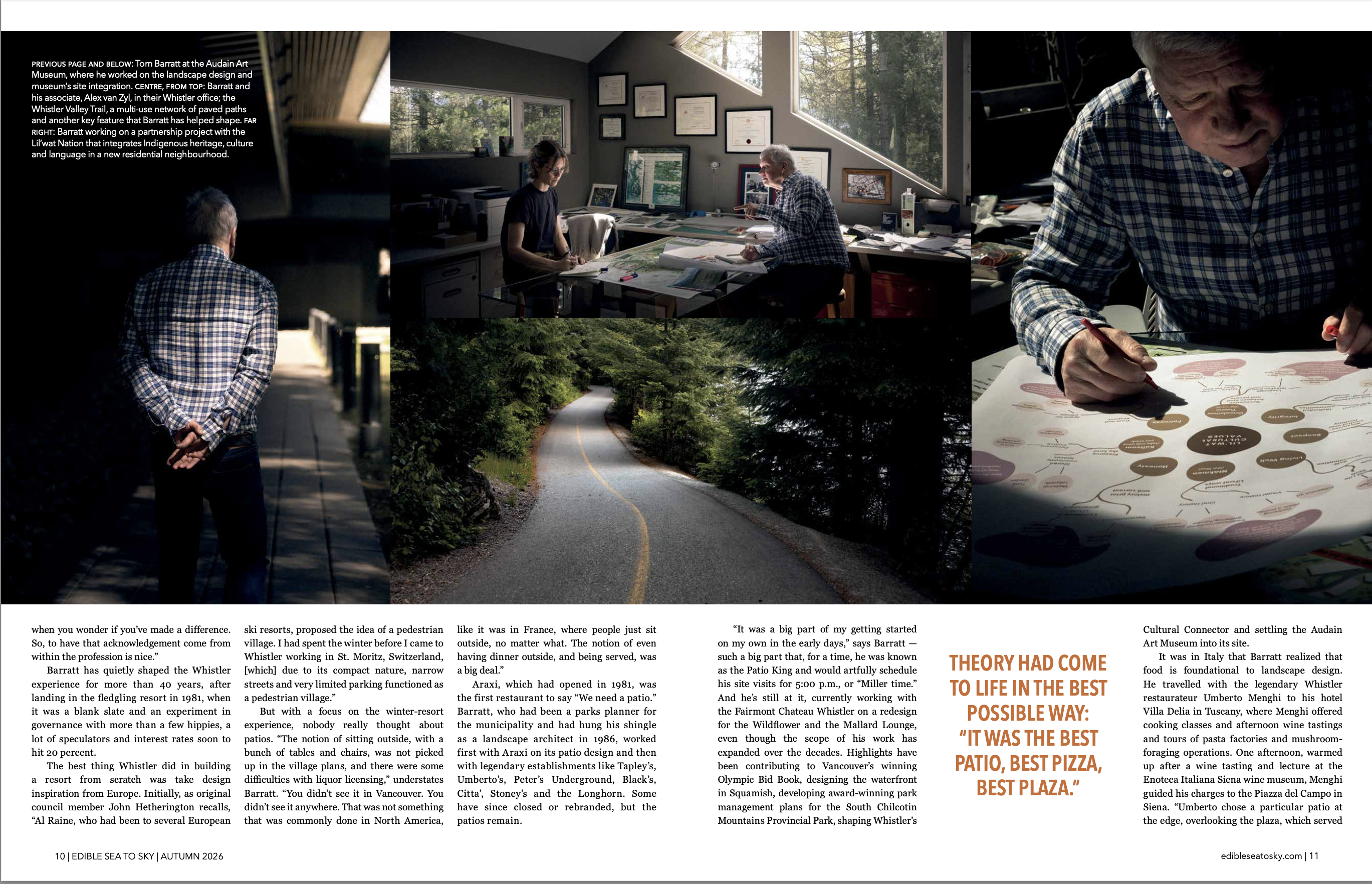
Barratt is Whistler’s longest-standing landscape architect. His dedication to designing the connective tissue between wild places and built spaces was acknowledged this spring by the Canadian Society of Landscape Architects. Becoming a member in the College of Fellows for his body of “outstanding professional work, individuality and mastery of the art of landscape architecture” is the professional equivalent of being in the hall of fame. “It’s nice,” reflects Barratt. “You get to a certain age and have a few middle-of-the-night moments when you wonder if you’ve made a difference. So, to have that acknowledgement come from within the profession is nice.”
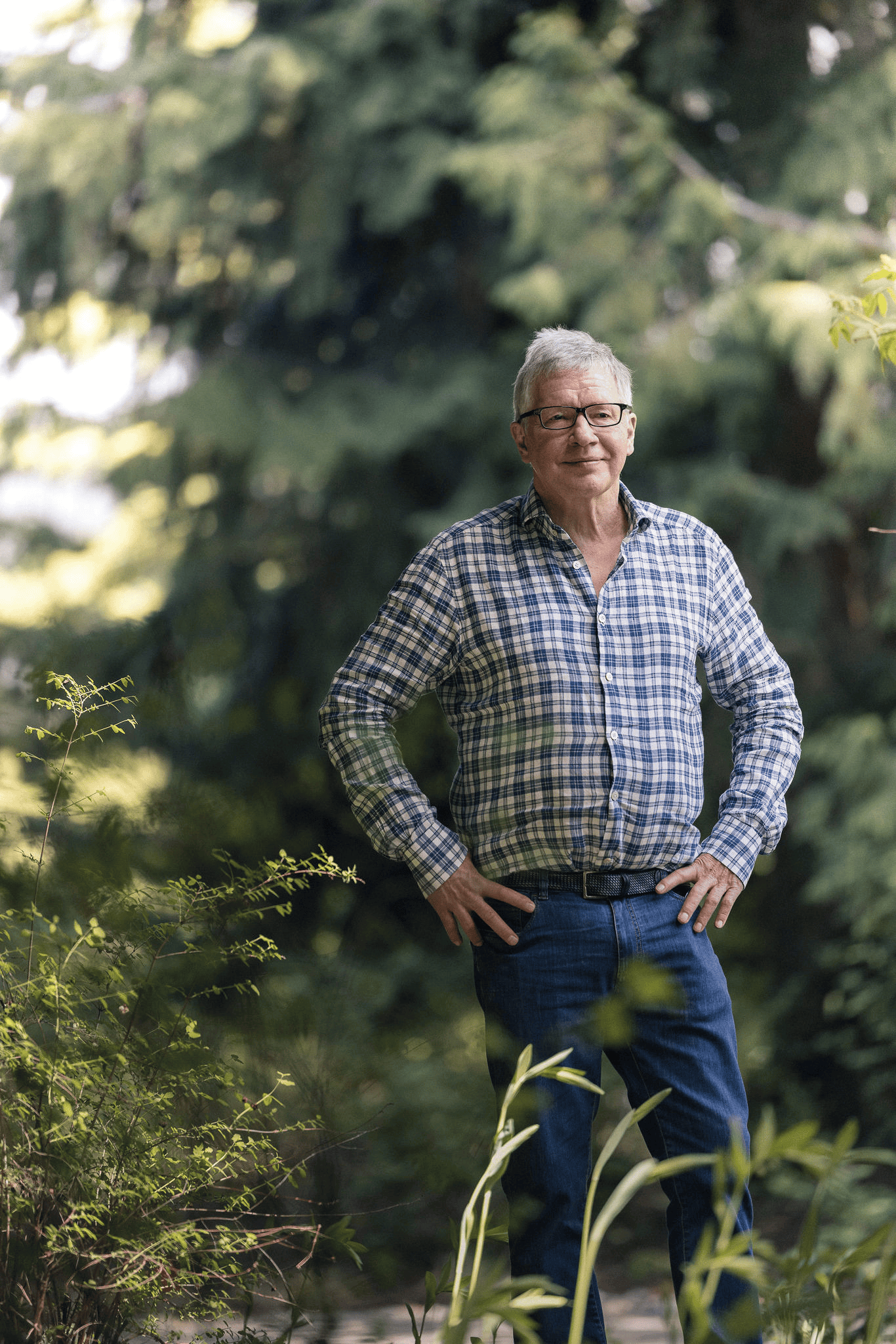
Barratt has quietly shaped the Whistler experience for 40 years, after landing in the fledgling resort in 1981 when it was a blank slate and experiment in governance with more than a few hippies, a lot of speculators and soon-to-hit-20% interest rates.
The best thing Whistler did in building a resort from scratch was take design inspiration from Europe. Initially, as original council member John Hetherington recalls, “Al Raine, who had been to several European ski resorts, proposed the idea of a pedestrian village. I had spent the winter before I came to Whistler working in St. Moritz, Switzerland, [which] due to its compact nature, narrow streets and very limited parking, functioned as a pedestrian village.”
But with a focus on the winter-resort experience, nobody had really thought about patios. “The notion of sitting outside, with a bunch of tables and chairs, was not picked up in the village plans, and there were some difficulties with liquor licensing,” understates Barratt. “You didn’t see it in Vancouver. You didn’t see it anywhere. That was not something that was commonly done in North America, like it was in France, where people just sit outside, no matter what. The notion of even having dinner outside, and being served, was a big deal.”
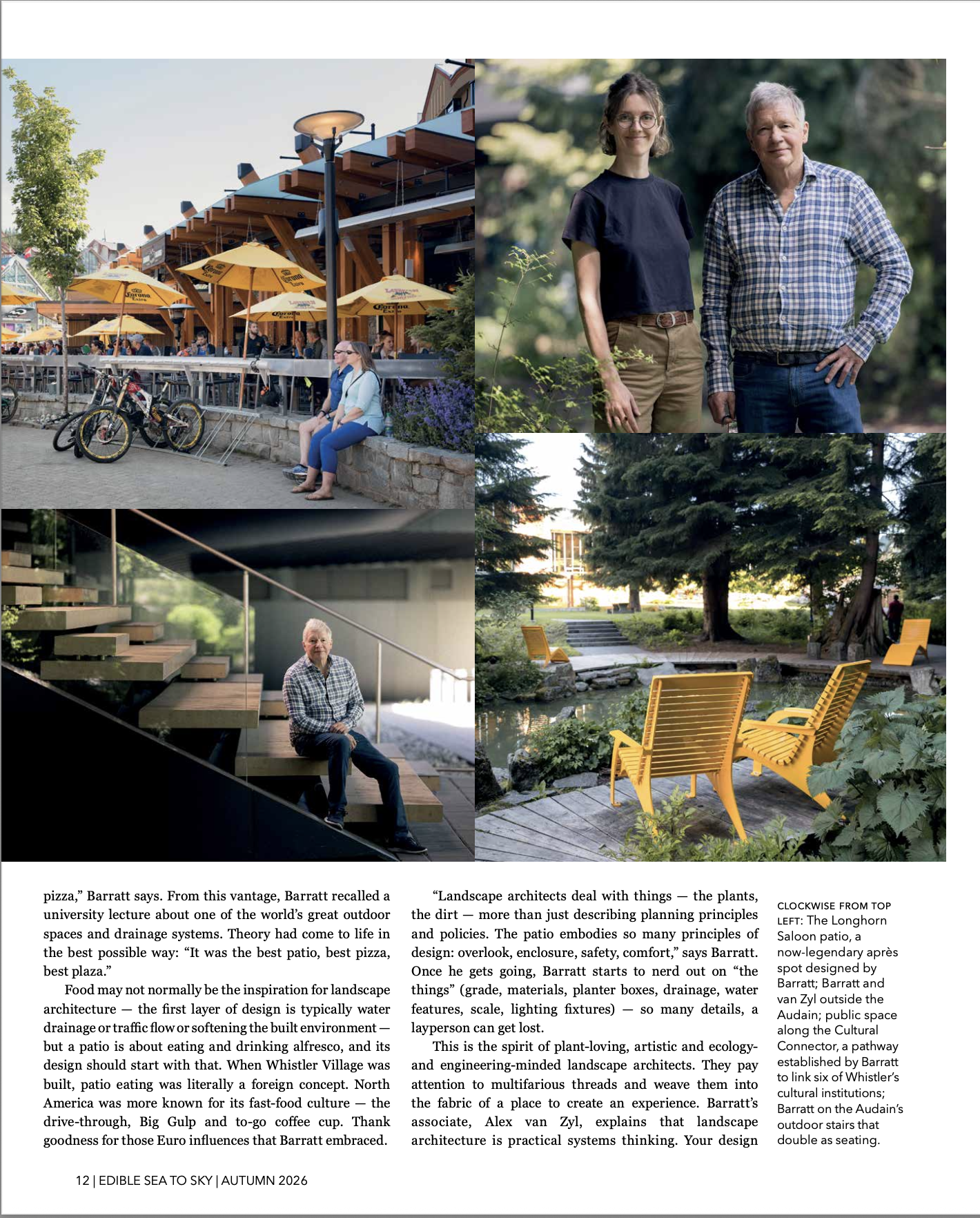
Araxi, which had opened in 1981, was the first restaurant to say: “We need a patio.” Barratt, who had worked as a parks planner for the municipality and hung his shingle as a landscape architect in 1986, worked first with Araxi and then with Tapley’s, Stony’s (now La Brasserie), Citta’s, Umberto’s, Pete’s Underground, Black’s, the Longhorn, and the Mallard, on their patio designs.
“It was a big part of my getting started on my own in the early days,” says Barratt — such a big part that, for a time, he was known as “the patio king” and would artfully schedule his site visits for 5 p.m. or “Miller time.” And he’s still at it — currently working with the Fairmont Chateau Whistler on a redesign for the Wildflower and Mallard Lounge, even though the scope of his work has expanded over the decades, to include highlights like putting together winning Olympic bid books, designing the waterfront in Squamish, developing award-winning park management plans for the Chilcotins Mountains, or shaping Whistler’s Cultural Connector from the Skate Park, to settling the Audain Art Museum into its site .
It was in Italy that Barratt realized the root of all landscape design should start with food. He travelled with the legendary Whistler restauranteur Umberto Menghi to his hotel Villa Delia, where Menghi offered cooking classes and afternoon tours of pasta factories, wine tastings and mushroom-foraging operations in Tuscany. One afternoon, warmed up after a wine tasting and lecture at the Enoteca Italiana Siena wine museum, Menghi guided his charges to the Piazza del Campo in Sienna. “Umberto chose a particular patio at the edge, overlooking the plaza, which served pizza.” From this vantage, Barratt recalled a university lecture about one of the world’s great outdoor spaces and drainage systems. Theory had come to life in the best possible way; “It was the best patio, best pizza, best plaza.”
Food may not normally be the inspiration for landscape architecture — the first layer of design is typically water drainage or traffic flow or softening the built environment — but a patio is about eating and drinking al fresco and its design should start with that. Unlike in Italy, North America’s greatest contribution to culinary culture has been the drive-through, the Big Gulp, and the to-go coffee cup. Patio eating, when Whistler Village was built, was literally a foreign concept. Thank goodness for those Euro influences that Barratt embraced.
“Landscape architects deal with things — the plants, the dirt — more than just describing planning principles and policies. The patio embodies so many principles of design — overlook, enclosure, safety, comfort,” says Barratt. Once he gets going, Barratt starts to nerd out on “the things” — grade, materials, planter boxes, drainage, water features, scale, lighting fixtures — so many details, a layperson can get lost.
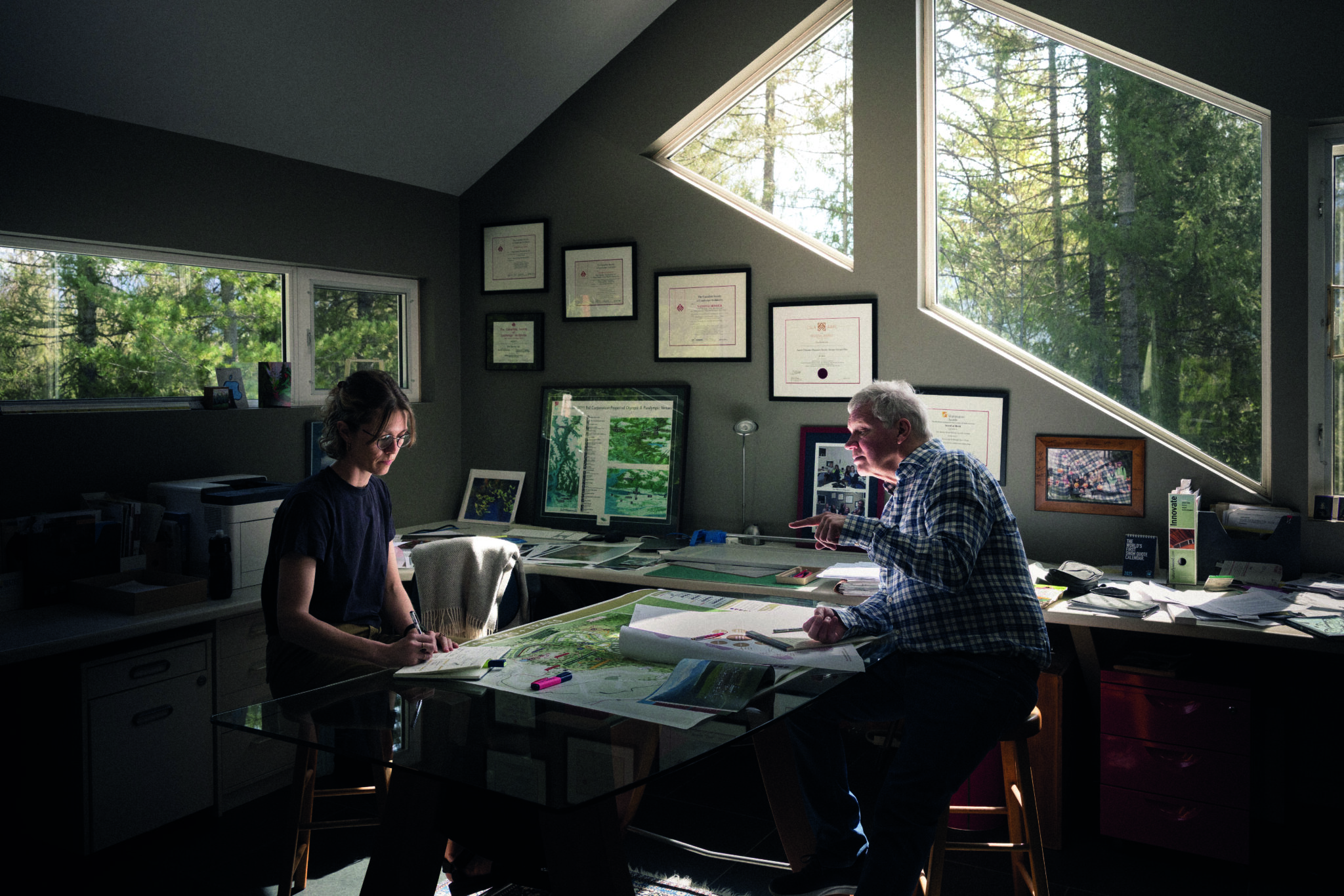
Landscape architects are a curious breed of plant-loving, ecology-minded, artistic engineers, who pay attention to all the layers that underlie the fabric of an experience. Barratt’s associate, Alex van Zyl, explains that landscape architecture is practical systems thinking. Your design involves planting a tree, but after you’ve done your work, the tree continues to grow. This is part of the invisible hand of good design — thinking about how the elements will interact and come to life. And that extends to the humans. “I’ve learned from Tom, not just how to design, but how to build community.”
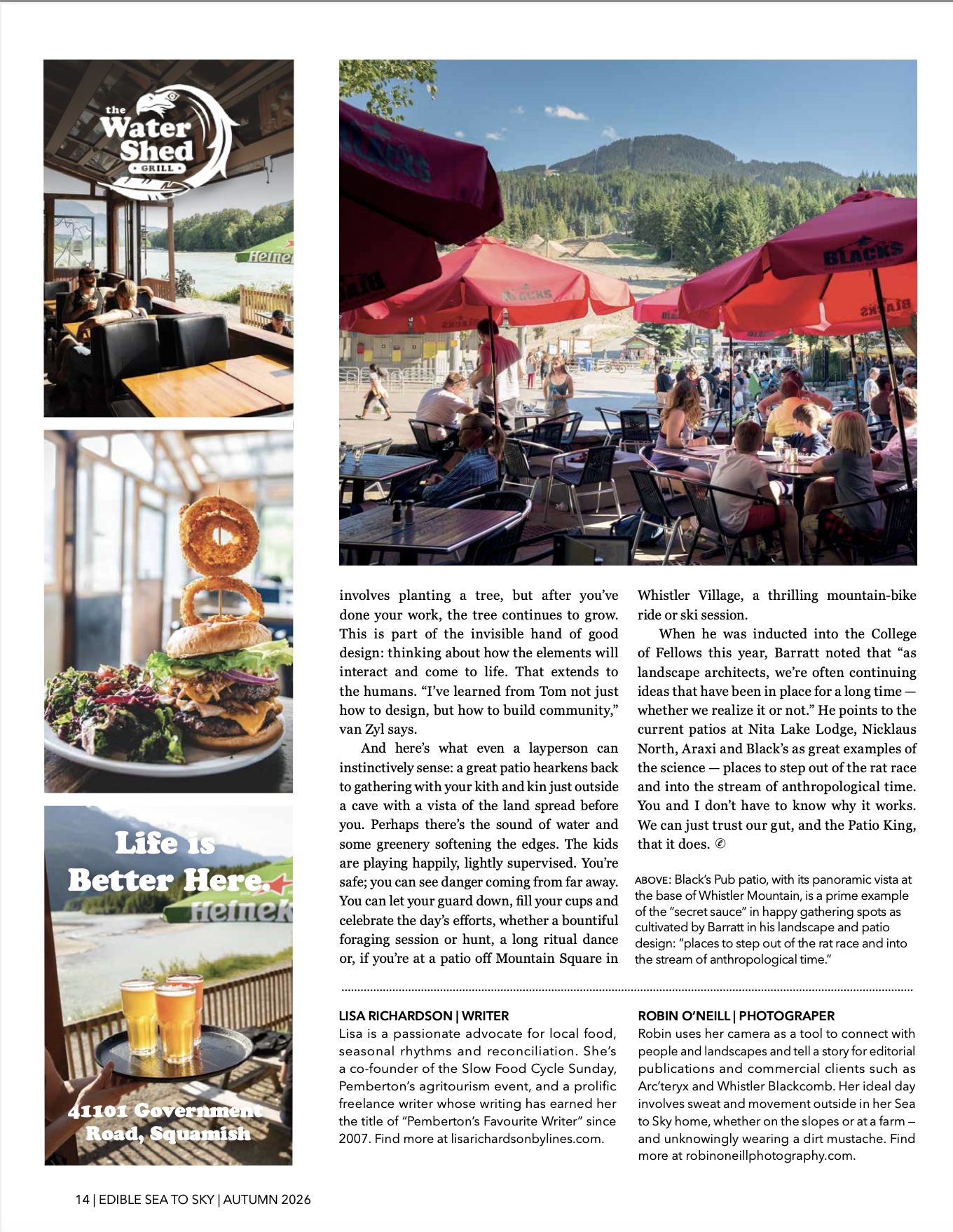
And here’s what even a layperson can instinctively grok: a great patio hearkens back to gathering with your tribe members under an overhang with a vista of the lands and cave at your back. Likely, there’s the sound of water, some greenery softening the edges. The kids are playing happily, lightly supervised, and you can let your guard down and fill your cups and tell some stories about the day. You’re safe and you can see danger coming from far away and celebrate the day’s effort, whether it was an epic foraging session, a huge hunt, a long ritual dance, or a massive mountain-bike ride.
When he was inducted this year into the Canadian Society of Landscape Architects, Barratt noted that “as landscape architects, we’re often continuing ideas that have been in place for a long time — whether we realize it or not.”
He points to the current patios at Nita Lake Lodge, Nicklaus North, Araxi’s and Black’s as great examples of the science — places to step out of the rat race and into the stream of anthropological time. You and I don’t have to know why it works. We can just trust our gut, and the Patio King, that it does.
This story is featured in the Fall 2026 issue of Edible Sea to Sky magazine, with photography by Robin O’Neill.


💕💕💕Sent from my iPadOn Sep 30, 2026,