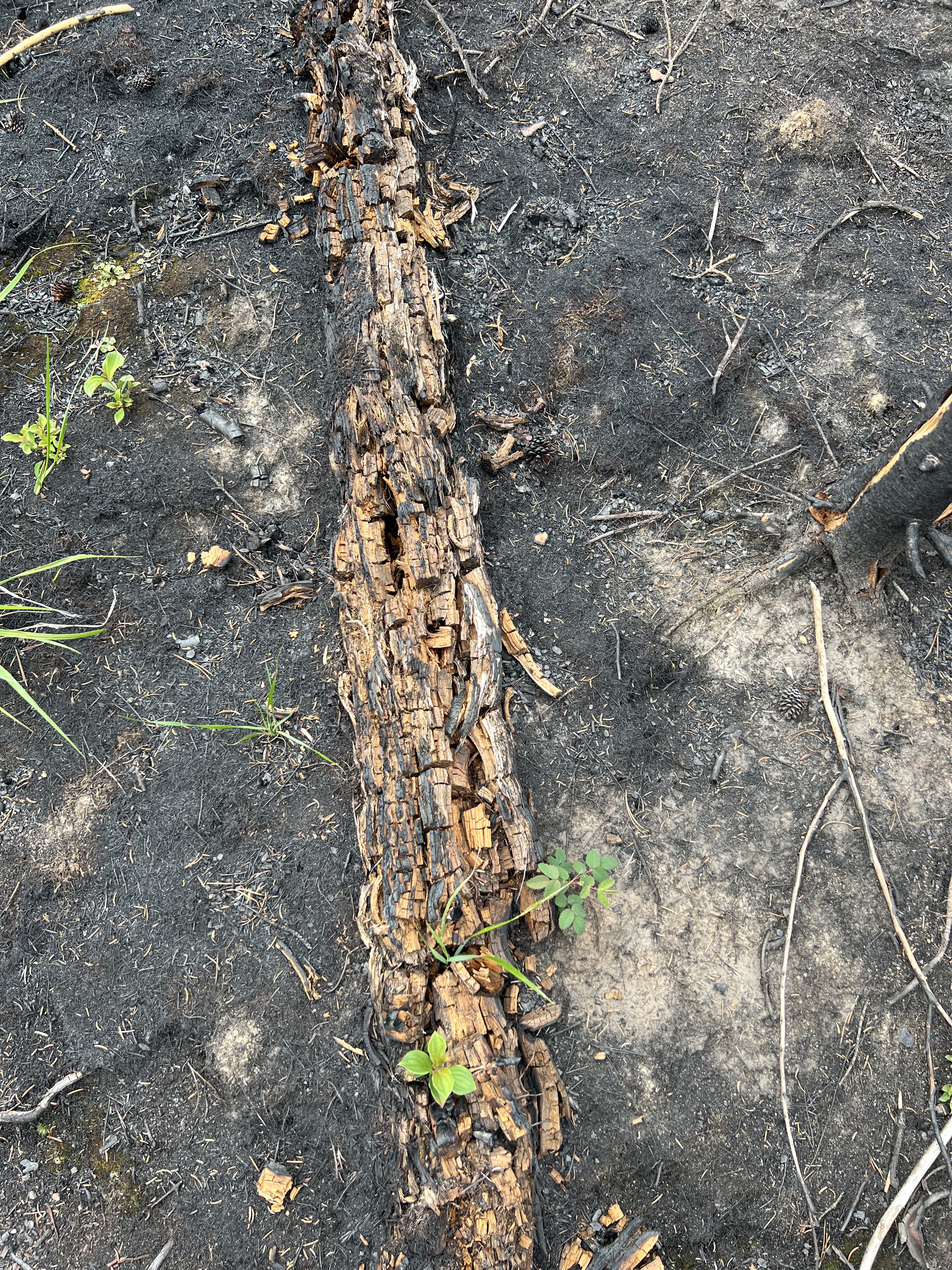
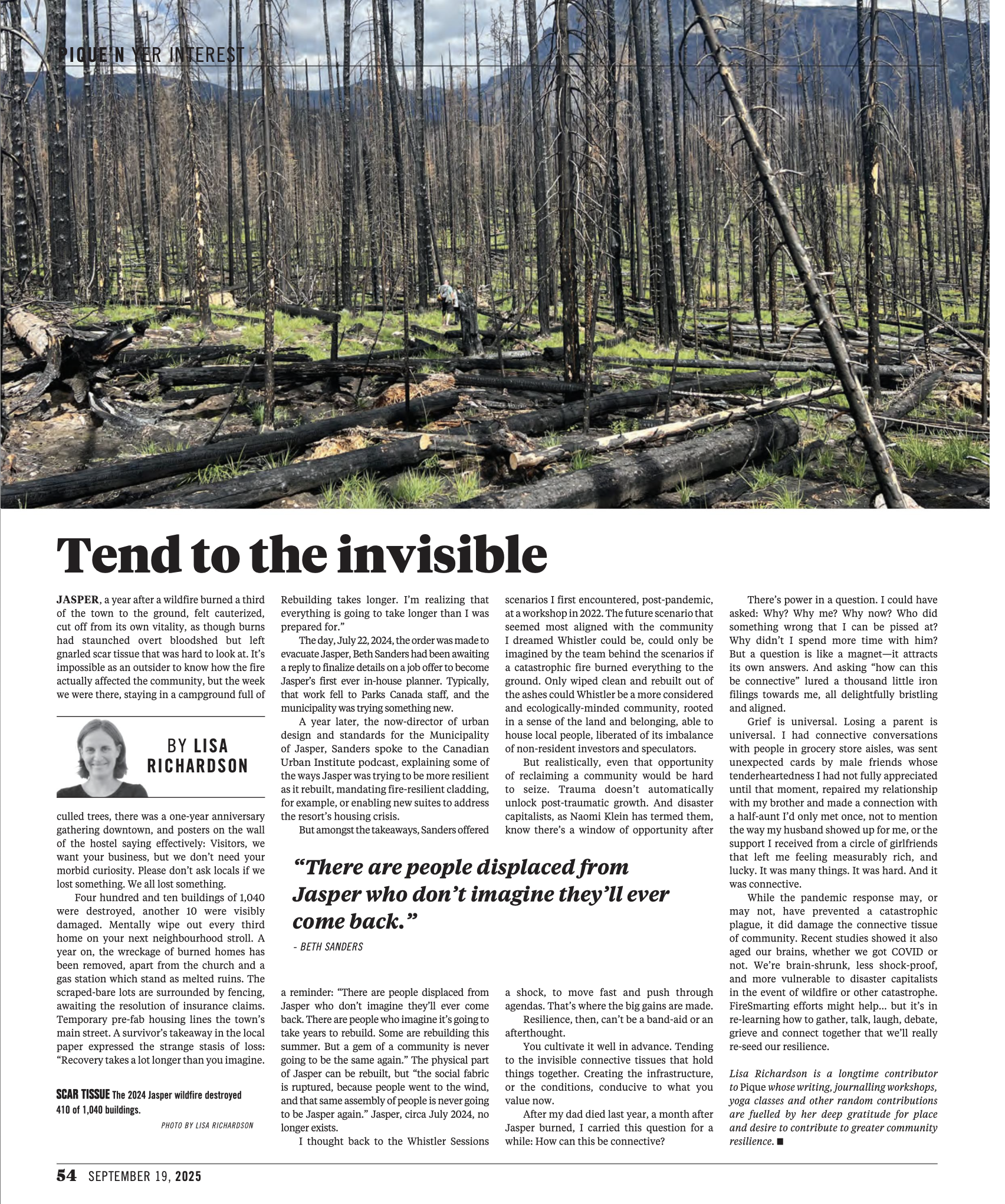
Jasper, a year after a wildfire burned a third of the town to the ground, felt cauterized, cut off from its own vitality, as though burns had staunched overt bloodshed but left gnarled scar tissue that was hard to look at. It’s impossible as an outsider to know how the fire actually affected the community, but the week we were there, staying in a campground full of culled trees, there was a one-year anniversary gathering downtown, and posters on the wall of the hostel saying effectively: Visitors, we want your business, but we don’t need your morbid curiosity. Please don’t ask locals if we lost something. We all lost something.

410 buildings of 1040 were destroyed, another 10 were visibly damaged. Mentally wipe out every third home on your next neighbourhood stroll. A year on, the wreckage of burned homes has been removed, apart from the church and a gas station which stand as melted ruins. The scraped bare lots are surrounded by fencing, awaiting the resolution of insurance claims. Temporary pre-fab housing lines the town’s main street. A survivor’s takeaway in the local paper expressed the strange stasis of loss: “Recovery takes a lot longer than you imagine. Rebuilding takes longer. I’m realizing that everything is going to take longer than I was prepared for.”
The day, July 22 2024, that the order was made to evacuate Jasper, Beth Sanders had been awaiting a reply to finalize details on a job offer to become Jasper’s first ever in-house planner. Typically, that work fell onto Parks Canada staff, and the municipality was trying something new.
A year later, the now-Director of Urban Design and Standards for the Municipality of Jasper, Sanders spoke to the Canadian Urban Institute podcast, explaining some of the ways Jasper was trying to be more resilient as it rebuilt, mandating fire-resilient cladding, for example, or enabling new suites to address the resort’s housing crisis.
But amongst the takeaways, Sanders offered a reminder: “There are people displaced from Jasper who don’t imagine they’ll ever come back. There are people who imagine it’s going to take years to rebuild. Some are rebuilding this summer. But a gem of a community is never going to be the same again.” The physical part of Jasper can be rebuilt, but “the social fabric is ruptured, because people went to the wind, and that same assembly of people is never going to be Jasper again.” Jasper, circa July 2024, no longer exists.
I thought back to the Whistler Sessions scenarios that I’d first encountered, post-pandemic, at a workshop in 2022. The future scenario that seemed most aligned with the community that I dreamed Whistler could be, could only be imagined by the team behind the scenarios if a catastrophic fire burned everything to the ground. Only wiped clean and rebuilt out of the ashes could Whistler be a more considered and ecologically-minded community, rooted in a sense of the land and belonging, able to house local people, liberated of its imbalance of non-resident investors and speculators.
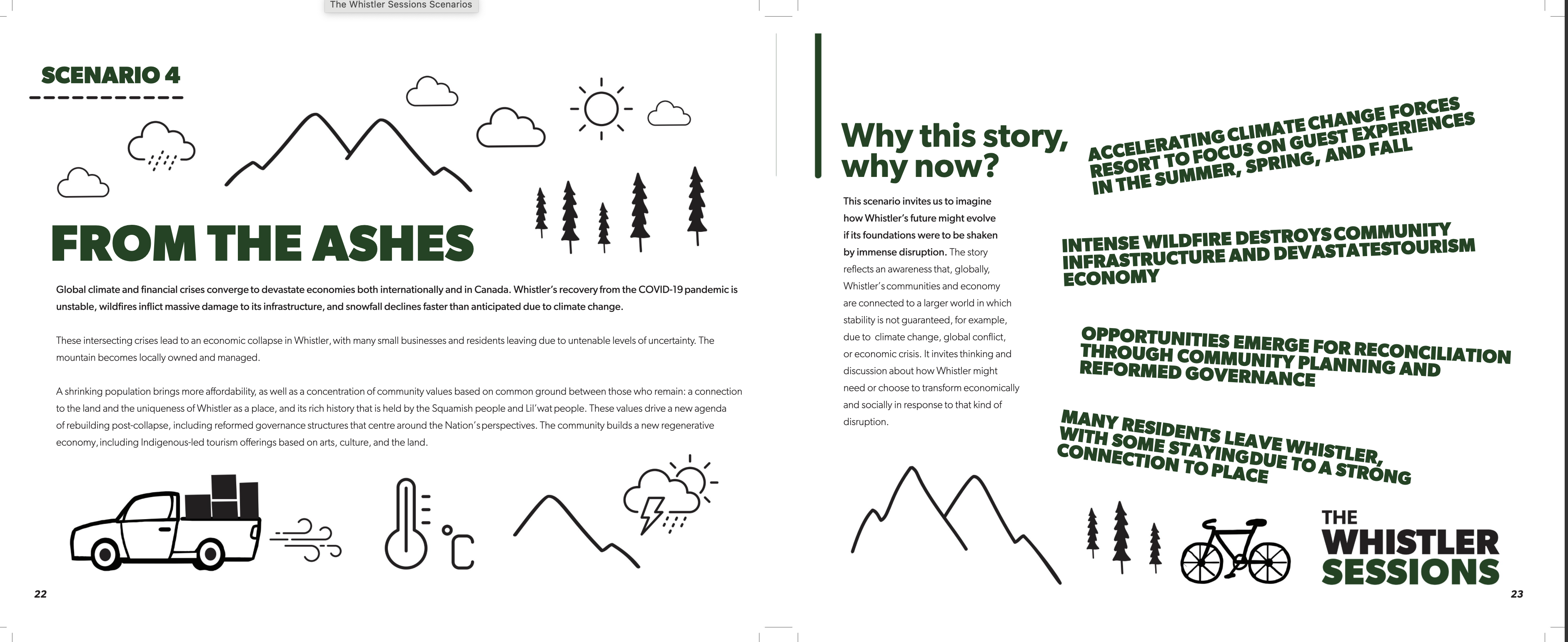
But realistically, even that opportunity of reclaiming a community would be hard to seize. Trauma doesn’t automatically unlock post-traumatic growth. And disaster capitalists, as Naomi Klein has termed them, know that there’s a window of opportunity after a shock, to move fast and push through agendas. That’s where the big gains are made.
Resilience, then, can’t be a band-aid or an afterthought.
You cultivate it well in advance. Tending to the invisible connective tissues that hold things together. Creating the infrastructure, or the conditions, conducive to what you value now.
After my dad died last year, a month after Jasper burned, I carried this question for a while: How can this be connective?
There’s power in a question. I could have asked: Why? Why me? Why now? Who did something wrong that I can be pissed at? Why didn’t I spend more time with him? But a question is like a magnet – it attracts its own answers. And asking “how can this be connective” lured a thousand little iron filings towards me, all delightfully bristling and aligned.
Grief is universal. Losing a parent is universal. I had connective conversations with people in grocery store aisles, was sent unexpected cards by male friends whose tenderheartedness I had not fully appreciated until that moment, repaired my relationship with my brother and made a connection with a half-aunt I’d only met once, not to mention the way my husband showed up for me, or the support I received from a circle of girlfriends that left me feeling measurably rich, and lucky. It was many things. It was hard. And it was connective.
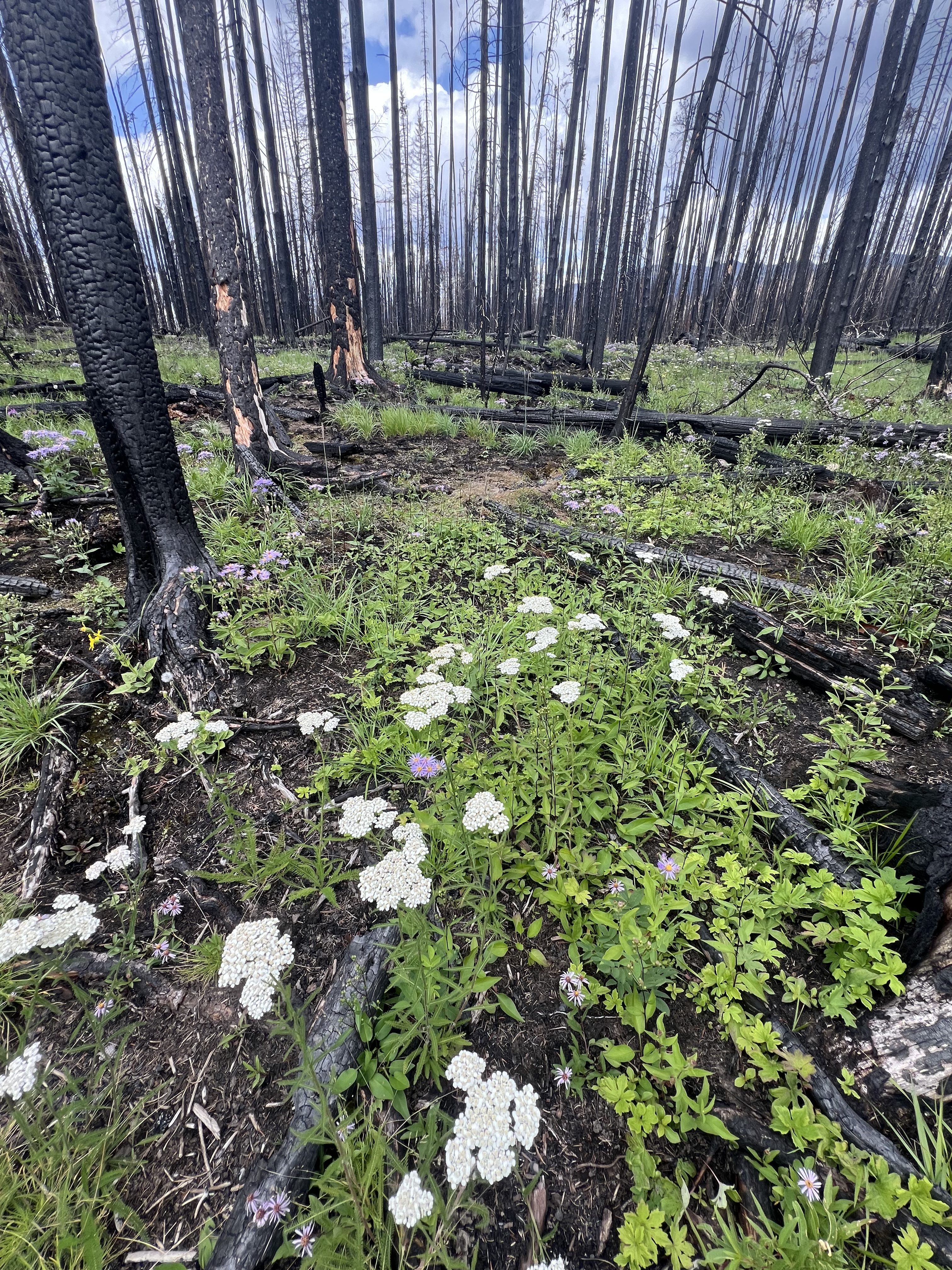
While the pandemic response may, or may not, have prevented a catastrophic plague, it did damage the connective tissue of community. Recent studies showed it also aged our brains, whether we got COVID or not. We’re brain-shrunk, less shock-proof, and more vulnerable to disaster capitalists in the event of wildfire or other catastrophe. Fire Smarting efforts might help… but it’s in re-learning how to gather, talk, laugh, debate, grieve and connect together that we’ll really re-seed our resilience.
 Lisa Richardson Bylines