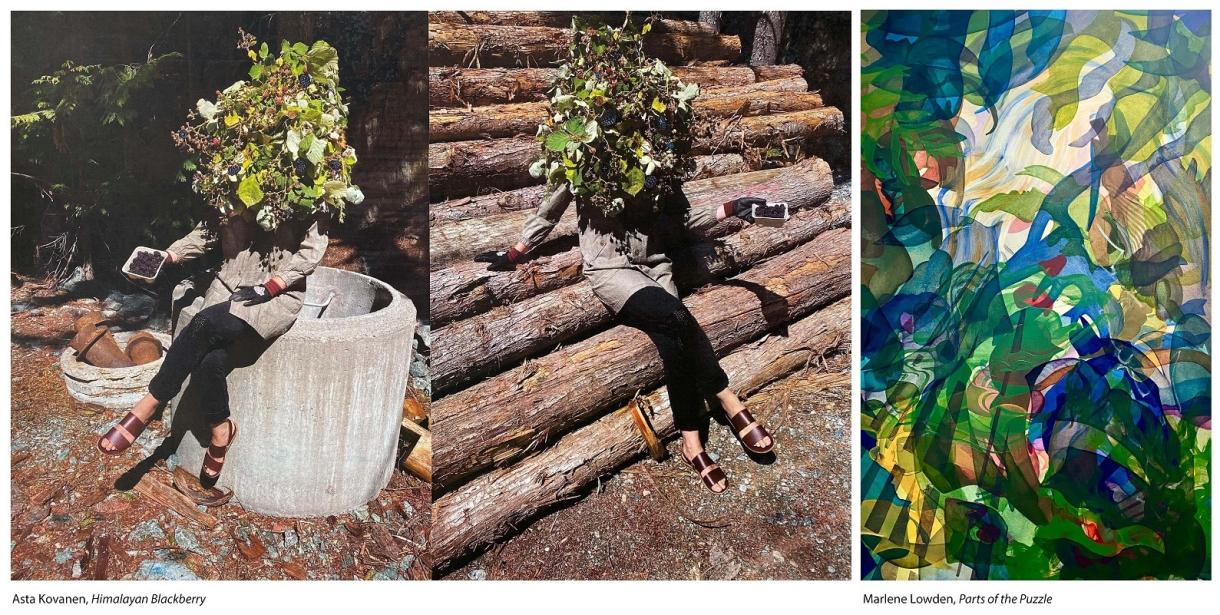
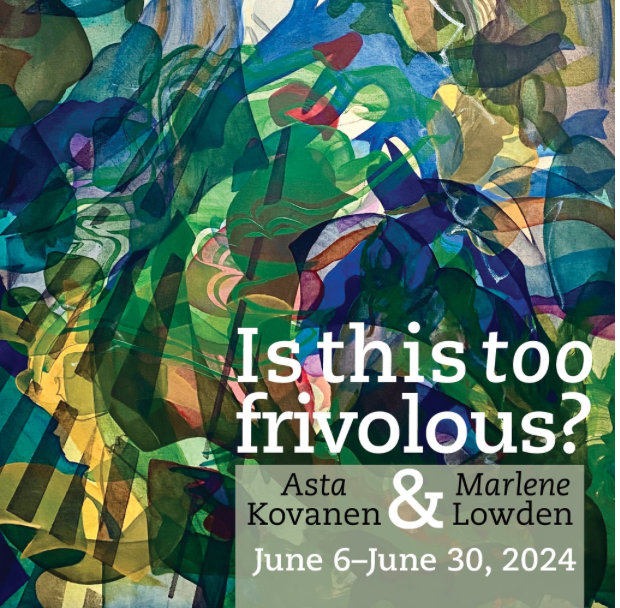
On Thursday, I got to attend the opening for a new art exhibit at the Ferry Building Gallery in West Vancouver, featuring my friend, Whistler-based artist, Asta Kovanen. Asta was paired by the jury with Marlene Lowden, a painter, and the two artists’ works juxtapose beautifully, as a way of pondering our relationship and roles within the natural world, and, as the exhibit declares, examining “the intersections between beauty, urgency, and surrealism in the face of climate change.”

Some people are easy to identify as artists – their body of work declares it. For others, it’s the way they pursue an income that makes the label or identity stick. With Asta, it’s a sensibility thing. Her whole approach to life is artistic – inquiring about things, playing with materials, exploring ideas in curious hands-on experiments. It’s really inspiring to be around a person who literally treats life as an ongoing series of art projects. I think Asta gets enough personal satisfaction from the creative process that she’s not very driven to publish or exhibit, which is why I’m so thrilled that this exhibit exists… I’d seen some of these photos earlier and heard a bit about this experimental inquiry, and it’s a delight to see it take a formal shape.
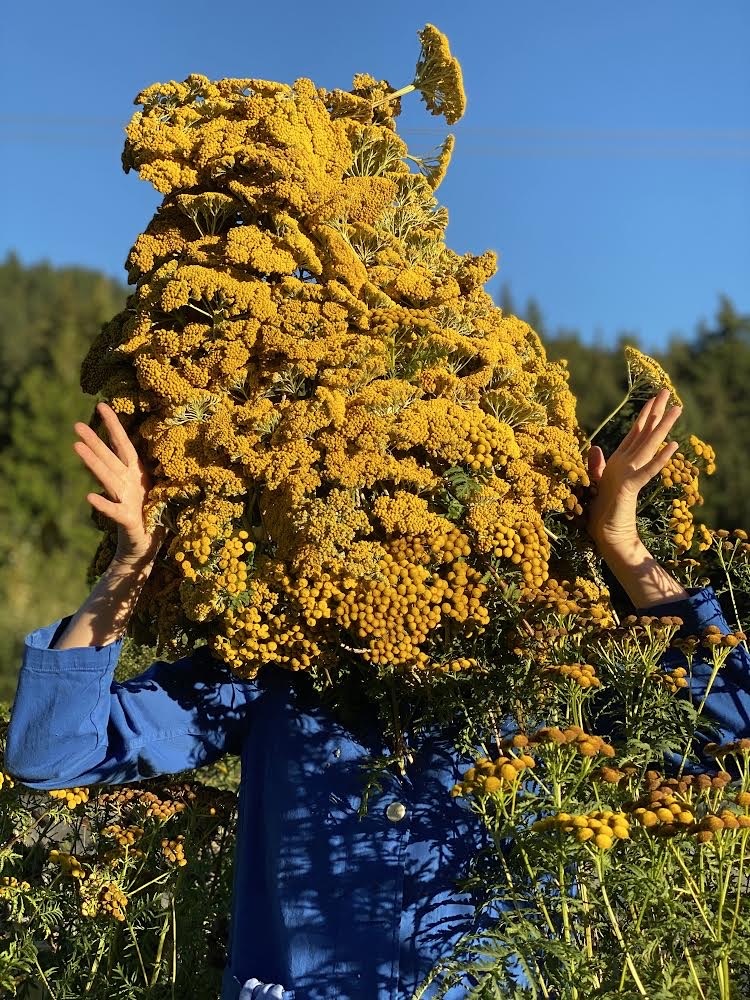
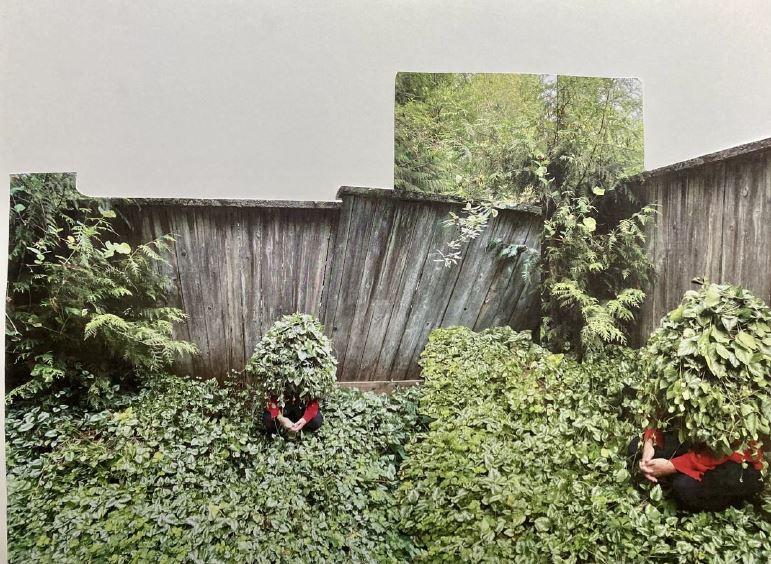
Asta describes her series, Travellers (We are all on the move now), as a series of eight headpieces constructed and worn during the pandemic (summers 2020-2022) as an uncomfortable meditation on changing landscapes and travelling/invasive plants.
As the exhibit blurb explains, “Each of Kovanen’s photographic collages captures the absurdity and adaptability of plant communities in the face of climate change, with an emphasis on delight instead of despair. She aims to spark conversations about environmental stewardship without adding to the viewer’s anxiety about the current conditions.”
Playing the professional versions of ourselves, we conducted this interview via email last night before she headed down to a real life artist Q+A at the gallery today.
Asta, your art is on exhibit for the month of June. What does June look like through your eyes? What plants and other beings are you noticing and paying attention to?
June is rich; plants are blooming and seasonal allergies are flaring. It’s also a high point for daylight so I was happy to be showing at the gallery this month since solstice seems like such a magical time of the year with its’ long daylight hours and the headiness of summer still fresh. Currently, I’m tuned into the scents of the forest. There is still a lot of skunk-cabbage blooming at higher elevations and the buds on young trees are still sticky & unfurling.
What plant or being is most inspiring to you right now/ serving as your Muse?
I’m distracted from my usual botanical obsessions by Seidi (our newish rescue husky). Living with and learning about her has been a wonderful, growing experience over the past half-year or so. Tuning into a creature and learning more about canine body language (especially in regards to trauma and reactivity) has made me want to lean into paying attention to the subtle cures that we are all giving off…
What “invasives” might we encounter in your show that are out there in the world right now?
This week I’ve seen scotch broom & mountain bluet blooming (and of course, burdock in various stages of growth).
How many pieces do you have in the exhibit? 11
They’re part of a series you created. How long was that exploration?
It was over a few seasons–starting in late summer of 2020 through 2022.
What plants did you focus on?
Eight plants…Burdock, tansy, lamium, morning glory, himalayan blackberry, butterfly bush, scotch broom and mountain bluet. The hitchhiking family was butterfly bush (from a section of the highway just north of Squamish which may have been removed now)
What prompted you to interrogate invasive species from the inside out?
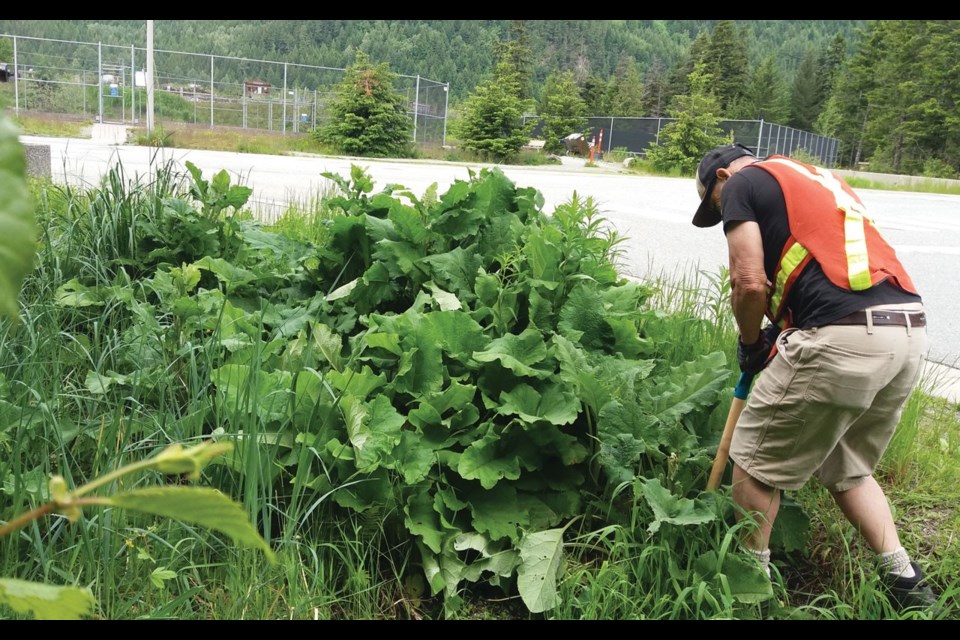
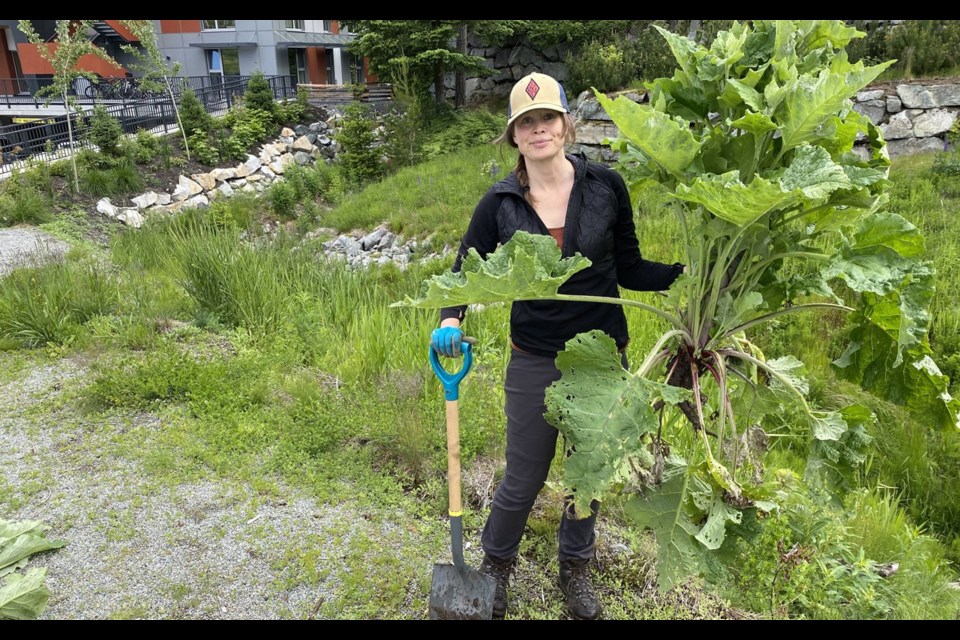
Honestly, I was spending so much time with the plants..mostly removing burdock but also hearing about and learning while Leslie was writing his in-depth book about the subject (over six years or so) that I finally decided that I better add my own spin to it in order to generate more personal interest rather than growing irritated at the fact that so many summer days were being spent in ditches digging burdock rather than swimming at the lake.

I love the name of your series and the idea that we are all on the move now. Can you say more about that? What does that mean to you?
At the time that I was making the first images, travel limitations (due to Covid-19 restrictions) were very much in place and real. I was curious about the fact that we humans were mostly grounded but that the very land I had landed on was being changed and continually changing due to human movement. We had become so accustomed to moving around that it hit people to stay put. It’s also a source of interest to me that many of us are somewhat plant blind and unaware of who we share the land with
You’ve spent a lot of time as a very supportive partner on a deburdocking Whistler mission. How many hours do you think you’ve logged deburdocking Whistler’s Valley trail?
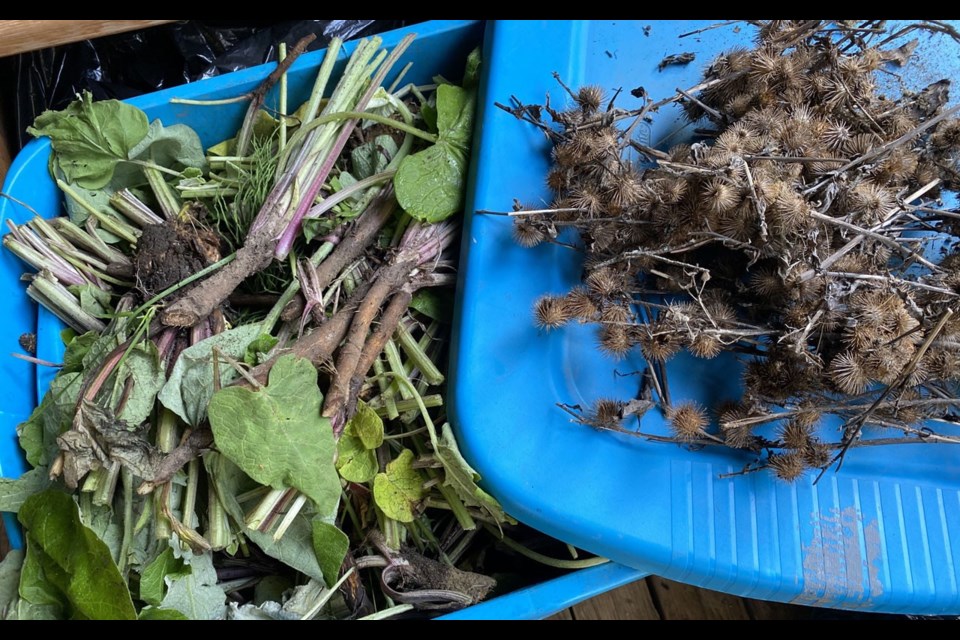
I have no idea how many hours… I admit that I’ve petered out of the project the last few years as Leslie’s successes of removing burdock accumulated. I basically help him move giant bales of burdock in tarps now but don’t do as much removal. It initially seemed so overwhelming and his dedication was so thorough that there have been significant reductions in the areas we initially focused on. And while it’s very satisfying to see other plants be able to repopulate areas there are new burdock populations popping up as new trails are developed so it’s an ongoing thing. Other people have jumped in to help which is amazing.
How did that hands-on battle provoke this line of inquiry as an artistic exploration for you?
I am a firm believer that there are material opportunities strewn about, all around us… each life has unique potential for creative exploration and often if initially I sense problem, it might instead be an opportunity which is dire need of a re-frame. The burrs that were irritating my skin (and mind) became something different as soon as I started thinking of sculptural opportunities (interesting fact: they are the inspiration behind the development of Velcro).
I have seen the way the Sea to Sky Invasive Species team are educating people about invasives with a Bad Guys/Most Wanted creative approach. I feel as though you were inviting a kind of inquiry, in concert with the plants, to disrupt the “battle” narrative of us versus the invasives.
I don’t feel as if plants are ever doing anything wrong so the battle narrative has never spoken to me. I admire plants’ resilience and adaptability. I recognize their different modes of intelligence but also recognize that humans have facilitated their travel and that in many cases, it impedes other plants or creatures (the ideas of bears getting burrs matted in their fur or of bats getting trapped, those things gave energy to my participation in removal). It felt like a very simple and clear way to participate in tending to land.
Practically speaking, how the heck did you build those head-dresses?
Burrs have structural integrity of their own so I was able to craft the first one based on that (and protected my face and hair with a motorcycle helmet underneath) For the other plants I needed to support them so I built a cage using basketry techniques and then wove the plant material into the cage. Some plants were definitely more challenging to work with but I used anti-histamines and copper wire to smooth out the process 🙂

How has your relationship with these particular plants evolved since you explored them artfully? In a way, I felt like you were adopting the persona of a kind of Queen of Burdock, or Hitchhiking Family.
I do feel as if I was collaborating with the plants. Yes, I was pulling them/cutting them for the material but I also had no malice and really loved them all in a certain sense. Using my own body as the vehicle means that I had to consider each detail (the bloom and wilt time, the location, the outfit, the ability to walk/see, it all was different for each plant). The smell of each plant was different, the comfort (or lack of) in my body was radically different and having no face, but only ‘plant’ was actually quite soothing.
What do you think we have to gain by approaching some of these stickier or more friction-full relationships, artfully? What might that look like?
There really isn’t anything to lose by trying a new approach. I’d like to become ever more fluid in my relationships and identity as I age. I have no idea what that would look like but I do imagine it might be a more playful way to live.

Is this too frivolous? was the theme you were given by the gallery… Your language I think is more about absurdity and delight… How is that distinct from frivolity? How did you come to terms with the theme? (Where did you find alignment with it? Marlene shared that it’s very alive for her, as a full time artist, wondering if it’s okay/legitimate to spend time making art and doing beautiful things, in a world on fire.)
I take imagination somewhat seriously and don’t tend to use the word frivolous to describe myself or my work but I can understand how it seems to fit. But again, who decides what is serious and worth paying attention to in this/your life? Only you can really make those distinctions. I think my delight in the absurd is because I’m not sure who is making the distinctions. I do know that I am drawn to deep ecology & mystery however I also find hard science deeply mysterious.
Deep time and deep philosophy are equally baffling.
I think of absurdity and delight as similar to a zen koan; a puzzling moment that shocks or displaces your usual way of thinking into a slightly altered version. No drugs needed.
Why do you choose to be so playful and surprising when tackling these alarming topics?
I don’t necessarily choose to be playful but in younger, more strident, versions of myself tried out being self-righteous and rigid/right. it didn’t feel good and it didn’t ever last long. Difficult subjects can be approached respectfully (reverentially even) but I don’t think we need to punish ourselves in order to show that we care about things.
Your botanical obsession is not limited to surreal photo shoots and invasives. You also spent a year sketching one plant a day. Can you say anything about that project, and how it feels related to, or distinct from, your invasives project?
This goes back to the thought that all of our lives are already overflowing with material but sometimes it’s hard to distill it or focus it into a project. So I’ve learned to pick something/narrow the field and work with it until something emerges. Allow the limitation to become interesting. I love plants and don’t quite understand how we can live alongside them and not be gobsmacked every-single-day by this luxury. Drawing can be a tool to increase looking. So drawing a plant a day really was a chance to look again and again at the beings who, in a way, are my neighbours.
In that way it is similar to the invasives project. To look and look again.
The difference was the messy, physical engagement while building the headpieces. It was awkward and heavy on my body and blinded my senses while the daily-drawing (and then abtracting) project was much cleaner and more cerebral perhaps. Thinking about the plants, watching and looking rather than wrestling with…:)
 Lisa Richardson Bylines