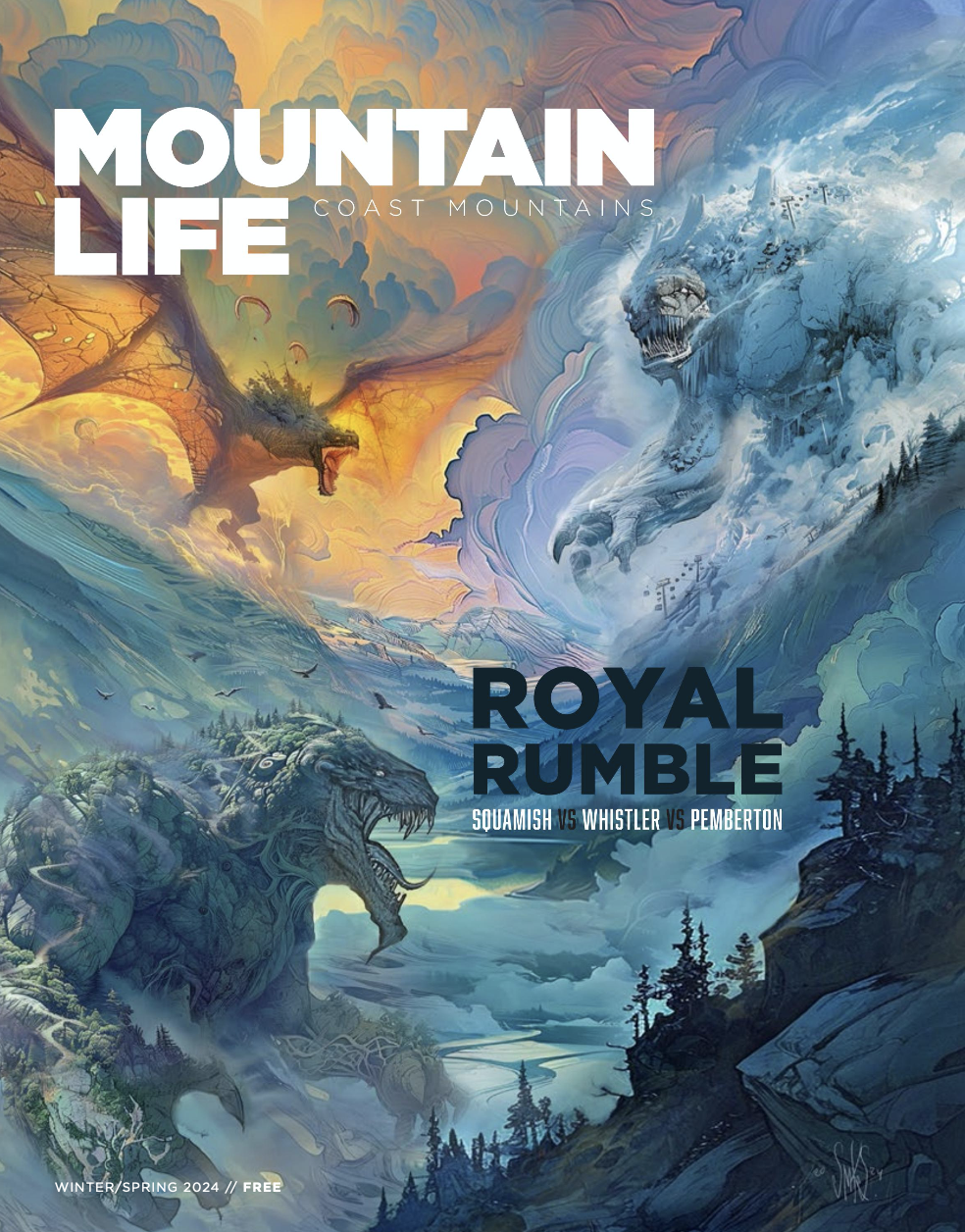
In the spring issue of Mountain Life, Coast Mountains, the communities of the corridor flex on their unique attributes. I got to speak for Pemberton. via https://www.mountainlifemedia.ca/2024/03/royal-rumble-pemberton/
Wayne Andrew, Líl̓wat horseman and a legendary rodeo rider in his prime, told me recently how Pemberton got its name. A story his grandfather told him. Passed on from his grandfather. The first white people paddled into the valley in birchbark canoes. Pale with scurvy. “We used cedar dugout, not birchbark, canoes—so it was shocking on lots of levels,” Andrew shared.

“What is this place?” the newcomers asked. ‘‘Puwámten’,” replied the Líl̓wat, meaning “the canoe log where the canoes beach, where people would pull up and berth their canoes.” (“Puwám” is the sound the canoes make when they beach on the log and “ten” is the tool used.) “Oh, that sounds like the name of the surveyor general,” they said. And so they called the place Pemberton, after a mustachioed dude in Fort Victoria—the boss of the boss of the boss, the biggest honcho in the Hudson’s Bay Company.
The sáma7 (pronounced “shama,” meaning “white folk”) were low on food and unwell, so the Líl̓wat welcomed them, shared dried meat and berries. Later, after a rockslide came down to where they’d set up camp, the newcomers moved further upstream, up the valley, closer to what is now settled as Pemberton. In Ucwalmícwts, the language of the Líl̓wat, the word for Pemberton, nkúkwmá, means “north.”

The Líl̓wat were spread all through the valley and hillsides, Andrew told me, but a smallpox epidemic decimated so much of the population it made it easier for the RCMP and Indian Agents to round them all up and move them onto a reserve.
Pemberton has its share of nicknames, depending on the era you landed—Spud Valley, Pemberhole, Pemberbush, Pemberdise—but October 2023 was the first time I heard “Puwámten.”
People tend to start the story of a place the moment they first arrive there themselves. As if nothing of real significance happened before you. Thus, my version of Pemberton starts around 2001, even though the Lil’wat have oral histories of connection with this land for 11,000 years and archeological sites dating back at least 5,500 years.
In 2001, my partner and I were arguing endlessly about where we should live. Whistler was too expensive, so the Squamish vs Pemberton debate was fierce. His requirements hinged on being able to do everything he loves—recreation-wise—out his back door, and at a world-class level. I scoffed at the audacity of such an expectation from life. But he was right. As a slew of pro athletes and lifestylers who landed in waves can attest.
Twenty years after Pemberton won our coin toss, the Village has doubled in size and is on track to reach 5,000 souls sometime within the next ten minutes. (It’s closer to 8,000 if you include the surrounding areas, and I’ve started to sound like the crusty locals who once greeted me with an, “I don’t recognise half the people around here anymore.”)

In my two decades, I’ve also learned a little more about the forces that shaped the place before I “discovered” it.
A volcanic eruption and biblical-level flooding 2,400 years ago left behind an incredible growing medium that now supports thousands of pounds of potatoes, incredibly potent garlic and the sweetest carrots and greens. Once the growing season begins, weekly harvest boxes from five different community-supported agriculture (CSA) growers roll out in blue bins to feed (and perplex) people up and down the Sea to Sky. (What do I do with a kohlrabi?)
The geology has other beneficiaries—mountain bikers, sledders, trail runners, skiers, anyone who likes going straight up, straight down, very fast, with speed.
Ray Mason, aka Pemby Iceman, has been sledding the region since he drove into the Pemberton Valley from the Hurley and his jaw dropped. He’d been skiing Whistler since it first opened—his dad was a part owner in the Mount Whistler Lodge—but here he found land with enough quiet space for horses, a private runway for his plane and a few groomed cross-country trails out his back door. He bought 60 acres in 1991, raised a family, ran a sled-guiding business for 15 years and still hasn’t tired of the landscape or “exploring the endless backcountry that only a few people get to see. I was mainly a skier, but once you get a sled…” He has shared beta and loaned his toboggan to a host of pro skiers and riders questing for their own first descents, including godfathering the late Dave Treadway’s 2013 mission to ski Mount Monmouth—the only peak apart from Mount Garibaldi above 10,000 feet in the Coast Range. (Check out the short film Let’s Go Get Small, which documents the adventure.)
Home to a solid concentration of female mountain guides and super-fast ultrarunning moms, Pemberton boasts the hardiest souls. In this land, weather is not abstract, and rivers have mood swings that keep everyone on their toes. It’s an intimate experience of heat, mosquitoes, wildfire haze, floods, collapsing mountains and debris flows as a warming climate and receding glaciers melt the permafrost holding a lot of rock together. (When I worked at the Squamish-Lillooet Regional District, our emergency services manager told me that a crack in Mount Currie had suddenly appeared, making it the fourth existential threat in the Pemberton valley. He’s since moved away.)
As an ecosystem unicorn where the Coast meets the Interior, we also have wilder residents—grizzly and black bears, great blue herons, western screech owls, red-listed sharp-tailed snakes and a unique species of salmon, the Birkenhead chinook.
Diehard ski and snowboard pros are still eking out a life in the mountains—Ian McIntosh, Joe Lax, Dave Basterrechea, JD Hare, Delaney Zayac—mixing up some combination of growing food, making things, banging nails and continuing to explore, while the next generation are making their own waves—Trinity Ellis on the World Cup luge tracks, her sweetheart Lucas Cruz on a mountain bike, cyclocross champ Ethan Wood, second-generation ski star Logan Pehota. But they’ve been the lucky ones.

Every time another family moves away in search of more affordable climes, or a retiring farmer sells to wealthy buyers and speculators who are thrilled to discover land at $35,000 an acre, I wonder just how hardy the next generation will have to be to grow their futures here. Are we just the last in a long line of “discoverers” who wreck what we found? Are we too far gone to listen to the wisdom that kept the Líl̓wat flourishing here for thousands of years? K’úl’tsam’, take only what you need. It’s not a novel idea. My yoga teacher pointed me to 3,000-year-old texts from the cultures of the Indus Valley that teach the same thing: ahimsa, do no harm, and brahmacharya, non-excess.
You can find the medicine still. Out on the land. Or in amongst the crowds. Go stand at the Remembrance Day parade, the Signal Hill pit cook, or a PORCA enduro race with volunteers in costume. Or at BMX night when the gate drops for the toddlers on run bikes, the Children’s Centre’s annual Christmas Bazaar, or the Lil’wat Rodeo—and you’ll see. You’ll see who and what is worth fighting for. Each other. And this land. Which has shaped us more than we’ll ever truly know.
 Lisa Richardson Bylines