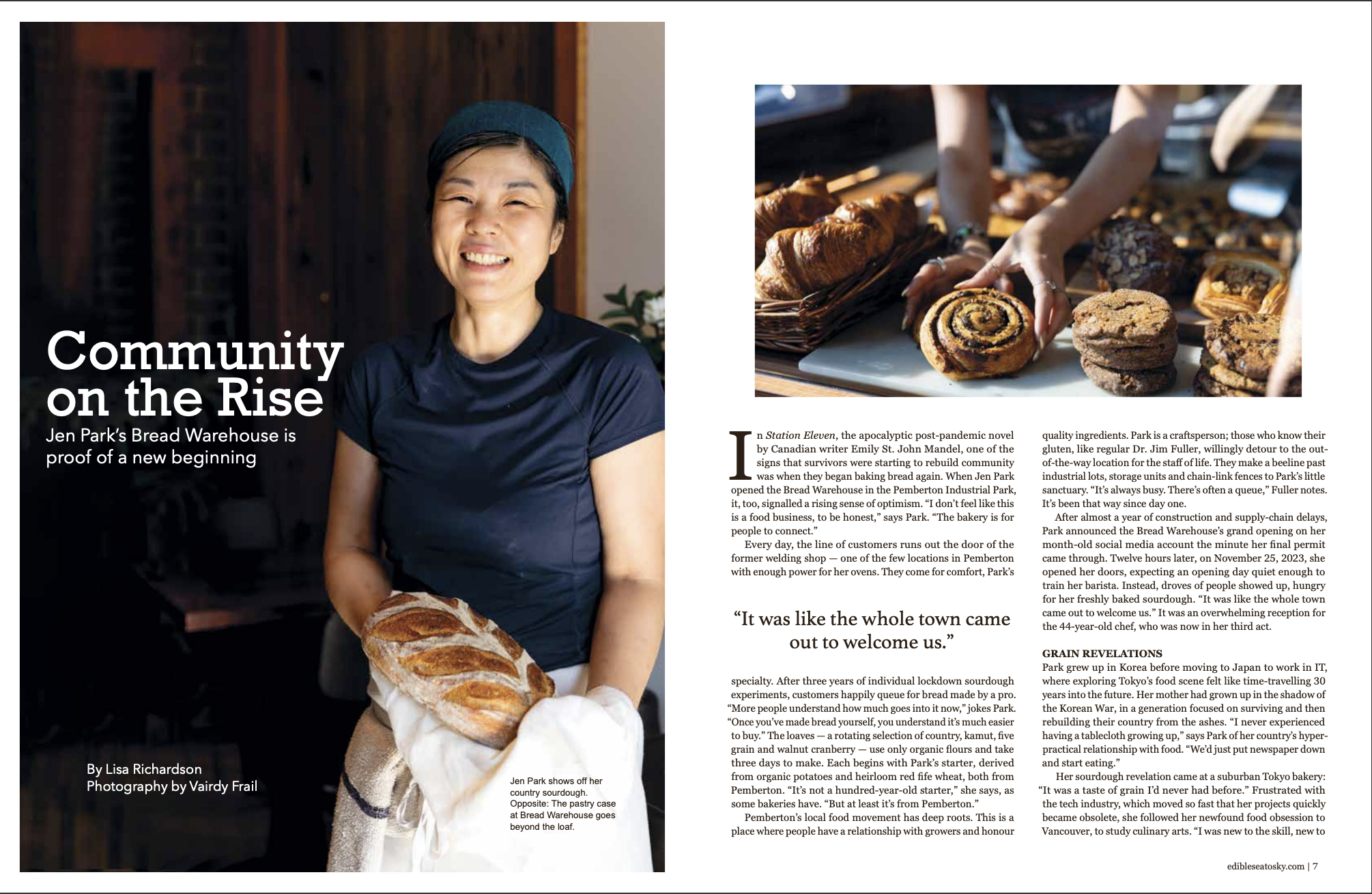
In Station Eleven, the apocalyptic post-pandemic novel by Canadian writer Emily St Mandel, one of the signs that the survivors were starting to rebuild community was when people started baking bread again. When Jen Park opened the Bread Warehouse in the Pemberton Industrial Park, it, too, signalled a rising sense of optimism. “I don’t feel like this is a food business, to be honest. The bakery is for people to connect.”
Every day, the line of customers runs out the door the former welding shop — one of the few locations in Pemberton with enough power for her ovens. They come for comfort, Park’s specialty. After three years of individual lockdown sourdough experiments, customers happily queue for bread made by a pro. “More people understand how much goes into it now,” jokes Park. “Once you’ve made bread yourself, you understand it’s much easier to buy.” The loaves – a rotating selection of country, gamut, five grain and walnut cranberry – use only organic flours and take three days to make. Each begins with Park’s starter, derived from organic potatoes and heirloom red fife wheat, both from Pemberton. “It’s not a hundred-year-old starter,” she says, as some bakeries have. “But at least it’s from Pemberton.”
Pemberton’s local food movement has deep roots. This is a place where people have a relationship with growers and honour quality ingredients. Park is a craftsperson; those who know their gluten, like regular Dr Jum Fuller, willingly devour to the out-of-the-way location for the staff of life. They make a beeline past industrial lots, storage units and chain-link fences to Park’s little sanctuary. “It’s always busy. There’s often a queue,” Fuller notes. It’s been that way since day one.
After almost a year of construction and supply-chain delays, Park announced the Bread Warehouse’s grand opening on her month-old social media account the minute her final permit came through. Twelve hours later, on November 25, 2023, she opened her doors, expecting an opening day quiet enough to train her barista. Instead, droves of people showed up, hungry for her freshly baked sourdough. “It was like the whole town came out to welcome us.” It was an overwhelming reception for the 44-year-old chef, who was now in her third act.
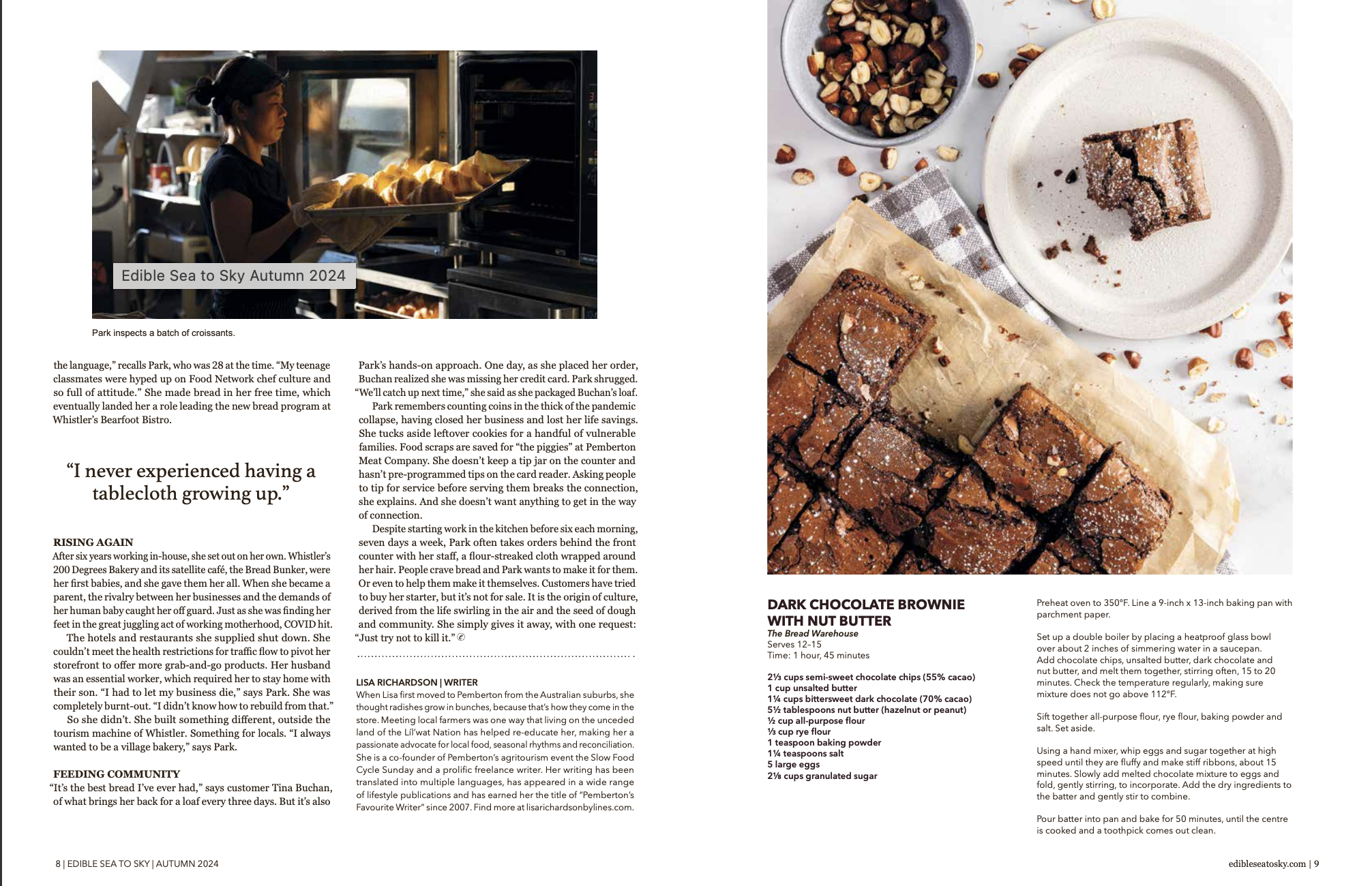
Park grew up in Korea before moving to Japan to work in IT, where exploring Tokyo’s food scene felt like time-travelling 30 years into the future. Her mother had grown up in the shadow of the Korean War, in a generation focused on surviving and then rebuilding their country from the ashes. “I never experienced having a tablecloth growing up,” says Park of her country’s hyper practical relationship with food. “We’d just put newspaper down and start eating.”
Her sourdough revelation came at a suburban Tokyo bakery: “It was a taste of grain I’d never had before.” Frustrated with the tech industry, which moved so fast that her projects quickly became obsolete, she followed her newfound food obsession to Vancouver, to study culinary arts. “I was new to the skill, new to the language,” recalls Park, who was 28 at the time. “My teenage classmates were hyped up on the Food Network chef culture and so full of attitude.” She made bread in her free time, which eventually landed her a role leading the new bread program at Whistler’s Bearfoot Bistro.
After six years working in-house, she set out on her own. Whistler’s 200 Degrees Bakery and its satellite cafe, the Bread Bunker, were her first babies, and she gave them her all. When she became a parent, the rivalry between her businesses and the demands of her human baby caught her off guard. Just as she was fining her feet in the great juggling act of working motherhood, COVID hit.
The hotels and restaurants she supplied shut down. She couldn’t meet the health restrictions for traffic flow to pivot her storefront to offer more grab-and-go products. Her husband was an essential worker, which required her to stay home with their son. “I had to let my business die.,” says Park. She was completely burnt-out. “I didn’t know how to rebuild from that.”
So she didn’t. She built something different, outside the tourism machine of Whistler. Something for locals. “I always wanted to be a village bakery,” says Park.
“It’s the best bread I’ve ever had,” says customer Tina Buchan, of what brings her back for a loaf every three days. But it’s also Park’s hands-on approach. One day, as she placed her order, Buchan realized she was missing her credit card. Park shrugged. “We’ll catch up next time,” she said as she packaged Buchan’s loaf.
Park remembers counting coins in the thick of the pandemic collapse, having closed her business and lost her life savings. She tucks aside leftover cookies for a handful of vulnerable families. Food scraps are saved for “the piggies” at Pemberton Meat Company. She doesn’t keep a tip jar on the counter and hasn’t pre-programmed tips on the card reader. Asking people to tip for service before serving them breaks the connection, she explains. And she doesn’t want anything to get in the way of connection.
Despite starting work in the kitchen before six each morning, seven days a week, Park often takes orders behind the front counter with her staff, a flour-streaked cloth wrapped around her hair. People crave bread and Park wants to make it for them. Or even to help them make it themselves. Customers have tried to buy her starter, but it’s not for sale. It is the origin of culture, derived from the life swirling in the air and the seed of dough and community. She simply gives it away, with one request: “Just try not to kill it.”

From Edible Sea to Sky magazine, issue #3, Autumn 2024

 Lisa Richardson Bylines